
MINNEAPOLIS — In early January, a quiet residential street in south Minneapolis became the epicenter of a national crisis that has shaken communities from coast to coast. What began as a federal Immigration and Customs Enforcement (ICE) operation on January 7 ended with the fatal shooting of 37-year-old Renee Nicole Good, an American citizen, mother of three, and community member whose life was cut tragically short.
Her death has reopened painful debates about federal enforcement practices, the use of force by law enforcement, and the price paid by ordinary families caught in contentious policy disputes.
The Incident That Sparked Outrage
On the morning of January 7, ICE agents were conducting enforcement operations in Minneapolis. Body-worn video and bystander footage showed federal officers approaching a maroon SUV stopped across a street. Officials claimed the vehicle impeded traffic and that the driver attempted to drive toward an ICE agent, prompting the use of lethal force.
Renee Good, who was behind the wheel of that vehicle, was struck multiple times and died at the scene, according to official reports. She leaves behind three children — a daughter aged 15, a son age 12, and her youngest, a 6-year-old boy.
Federal authorities, including Homeland Security officials and the Biden administration, described the shooting as a defensive action. However, community groups, civil rights advocates, and some eyewitnesses dispute that narrative, saying the available video and statements do not clearly support a claim of imminent danger that would justify lethal force.
Who Renee Nicole Good Was
Good was not a stranger to her neighbors. Those who knew her describe her as compassionate, creative, and deeply committed to her family and community. She had recently moved to Minneapolis to build a new life with her partner and children, and friends say she embraced her role as a mother while also engaging in creative pursuits such as poetry and community work.
Her partner, Becca Good, was in the vehicle with her at the time of the incident and was hospitalized afterward. According to family statements, the couple had chosen Minneapolis for its vibrant, welcoming community.
Good's family has described her as a person of kindness, affection, and joy — qualities that those who knew her say defined her daily life. Her sudden death not only robbed her children of their mother, but it has also left her loved ones and neighbors grappling with grief and unanswered questions.
Protests, Pressure, and Public Outcry
Good's shooting quickly became the site of protests and vigils in Minneapolis and other cities. Thousands have marched under banners such as "Justice for Renee Good" and "ICE Out of Minnesota." Religious leaders, community activists, and local residents have taken part in demonstrations calling for accountability, transparency in investigations, and changes to how federal agents operate in communities.
Public officials, including Minneapolis Mayor Jacob Frey and Minnesota Governor Tim Walz, have expressed concerns about the use of force and the broader actions of ICE in the state. They have urged calm but also demanded accountability and clearer investigative processes as the incident continues to unfold.
Polls suggest that public sentiment is divided. A recent Quinnipiac survey found that a majority of Americans viewed the killing of Good as unjustified, raising broader questions about law enforcement practices and community safety.
The Heart of the Family Left Behind
In statements shared by loved ones, the human cost of the tragedy is stark and deeply emotional. Becca Good has spoken of the pain of losing her partner, describing Renee as someone who believed in compassion, kindness, and building a better world for their children. The couple's youngest son — just six years old — now faces a future without both parents, a reality that has drawn national sympathy and grief.
Though the family's story is heartbreaking, community members and strangers alike have rallied to offer support. Fundraisers established shortly after the shooting have raised significant sums to assist with immediate financial needs, far exceeding initial goals and highlighting a groundswell of public empathy.
The images of impromptu memorials — flowers, handwritten notes, photos of Renee — dot the city landscape in Minneapolis, each a reminder of a life lost and the collective pause that followed.
National Conversations and Policy Implications
The killing of Renee Good has reignited debates about the use of force by federal law enforcement agencies, particularly ICE, whose mandate involves immigration enforcement rather than general policing in residential neighborhoods.
Human Rights Watch and other civil rights organizations have criticized the shooting as unjustified and called for independent investigations, asserting that evidence contradicts federal assertions of Good posing an imminent threat.
At the same time, federal officials continue to defend the agent's actions, citing claims of self-defense — positions that have only deepened the divide in public opinion and political rhetoric surrounding immigration enforcement.
This divide reflects larger national tensions over immigration policy, federal authority, and community trust in law enforcement — issues that have been central to political discourse in recent years.
Hypothetical Support from Public Figures
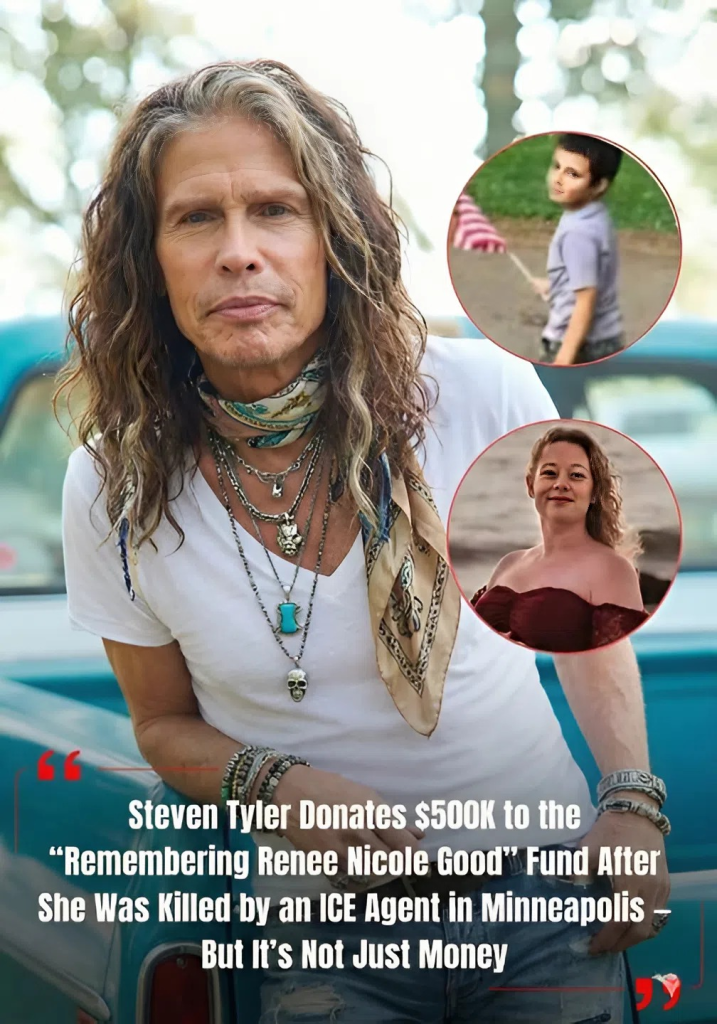
In moments of national tragedy, public figures often speak out to show solidarity, donate to support families, or draw attention to broader issues. While there is no verified report that rock singer Steven Tyler has donated to a fund or personally reached out to Renee Good's son, such gestures by public figures — real or hypothetical — can shape public conversation and highlight the human elements of loss and resilience.
For instance, when celebrities or artists support relief efforts or foundation funds, they bring additional visibility to causes and amplify voices that might otherwise be overlooked. Hypothetical contributions — such as dedicating financial support, educational funds, or even simply using a platform to advocate for justice and compassion — can become part of how communities process grief, honor legacy, and seek accountability.
But in the current situation, reports remain focused on community-led fundraisers, grassroots support, and local advocacy efforts. Any discussion of celebrity involvement should be clearly distinguished from confirmed facts.
The Path Forward: Healing, Accountability, and Reform
As investigations continue and protests persist, the tragedy of Renee Good's death serves as a focal point in a larger discussion about law enforcement reform, federal enforcement strategies, and how communities can be protected while respecting constitutional rights.
For families like the Goods, the question is personal and immediate: how does a community support children who have lost parents? How do neighbors and strangers alike respond with empathy without exacerbating division?
For policy makers, civil liberties organizations, and law enforcement agencies, the question is systemic: how do federal operations balance enforcement goals with community safety and constitutional protections?
These discussions are difficult, emotional, and deeply necessary.
Remembering a Life, Not Just a Headline
Renee Nicole Good's death is not just another story about law enforcement use of force. It is a reminder that policy disputes happen around real lives, in real neighborhoods, affecting real families.
Her legacy — as a mother, partner, and member of her community — deserves to be remembered with nuance and compassion, even as the nation continues to debate the broader issues surrounding her death.
As Minnesota and the country grapple with these questions, the hope expressed by her loved ones — for compassion, peace, and unity — remains at the heart of a conversation that extends far beyond Minneapoli